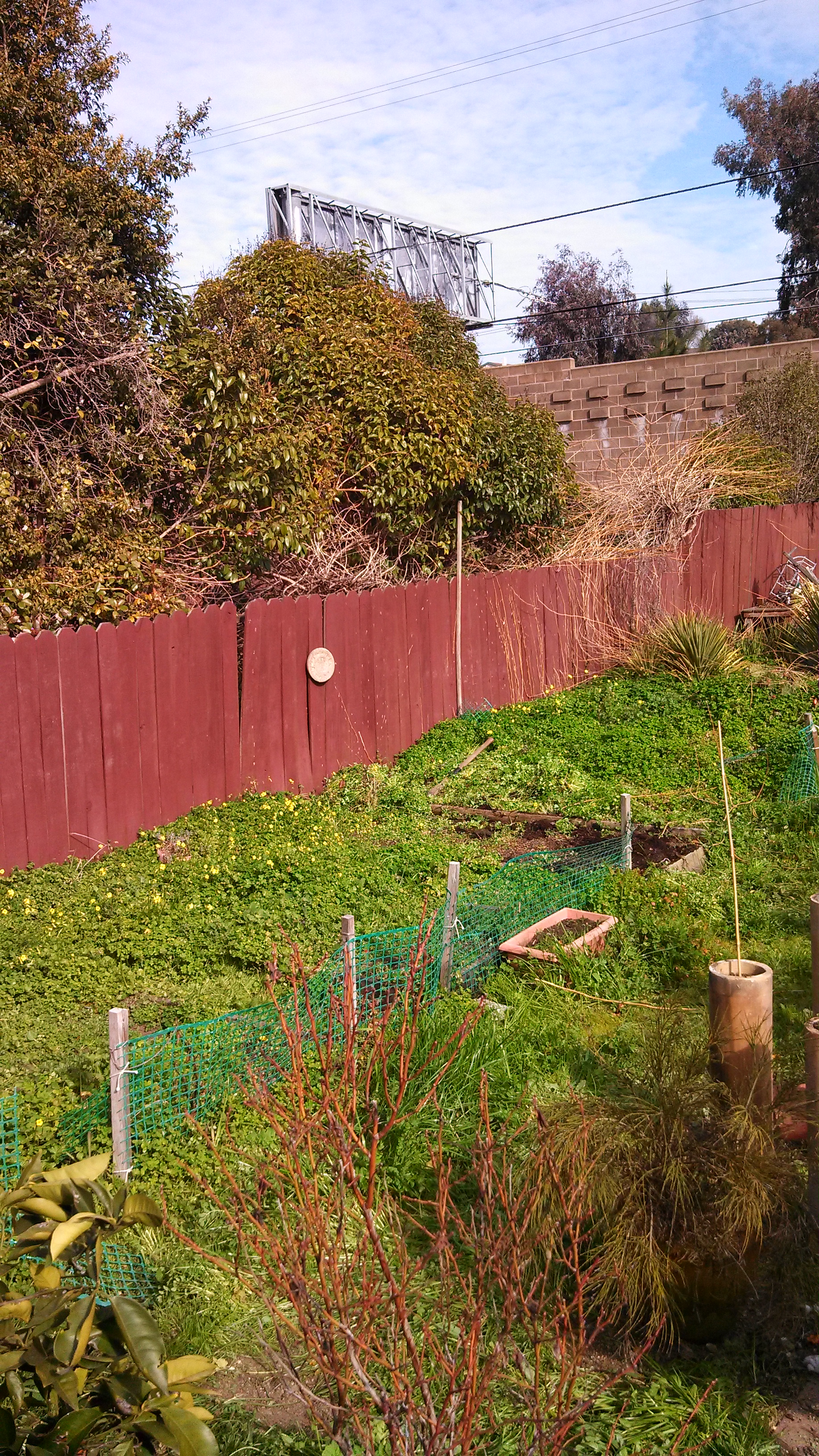
This Saturday I stuck my head out the back door into what has become a unchecked cacophony of free growth. Imagine that, Free Growth in my back yard. It is like the hippies are back . . . and they are growing things . . . I am not sure if I should call my Democrat or Republican representative. I mean there must be a law against free growth!! We just can not have things growing willy-nilly anywhere they decide to put down roots. Why, that is just un-natural!!
What? You say it is natural? Well I do not like it! I do not like it because . . . well . . . it is just messy, that is why! All the mess and silliness aside, it was good to be back in my garden. It always makes me feel like I have control over something (Ha!). The best part of it all is that I got to see one of my favorite actors again, in a fantastic movie, all in preparation for this year’s planting season. (So I tell myself.)
Now mark my words, I have it from a very reliable source that there will be Growth in the Spring. This clip is one of my all time favorite scenes with Peter Sellers in the film Being There. Heck I believe him every time I watch it. It is the one thing that gets me off of my duff each winter. This time especially, he has given me real inspiration with his refreshing and optimistic statements. So much inspiration that I attacked my back yard madness with brute force and began beating back the madness.
 The back half of my yard has always been covered with grass. For the first few years of living here I diligently watered, fertilized, weeded and mowed my little portion suburbia. It was lush, it was green and it soon became the place where the dogs went first thing in the morning. After learning that lawn fertilizer might cause cancer in dog paws and watching my water bill skyrocket every summer I took a hands off approach to lawn maintenance. In the ensuing years the pretty little Kentucky Bluegrass blades gave way to the hearty survivor species . . . Crabgrass. In truth, after a good rain and a trim, it looked pretty back there. Nice enough to sit by an open fire, enjoy a bottle of Malbec with some pan-fried brussel sprouts garnished with proscuitto and figs and pan deglazed with balsamic vinegar and maple syrup.
 So out it came, but not without a fight. I used a cool tool called a sod cutter to cut the grass right off of the soil. With the help of some handy men we removed all of the grass in a 50′ x 25′ section of the yard and set the cuttings aside to compost. Composting old lawn is not easy. It requires time and plastic. I am not optimistic but in for a penny . . .
After the easy job of cutting and removing the sod I tucked into soil preparation with a vengeance and a roto-tiller. As you can see by the accompanying video I was a little unprepared for just how hard the clay soil is here where I live. Now, I did wait a month after the last rain so the soil would not be soggy reasoning that it would be soft enough but not sticky. I guess I underestimated the drainage potential of my crabgrass stricken acreage. None-the-less I persevered, learned how to properly operate the roto-tiller and was able to sufficiently chew up the remaining square feet needed to place my new planting beds.
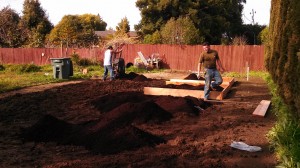 Ten yards of Clodbuster soil, 24 – 2″ x 10″ x 8′ boards and a box of galvanized 16 penny nails later my new planting beds were taking shape. With the addition of six 8′ x 8′ beds I have increased my planting are by 75%. I am not sure if I am crazy, excited or a little bit of both but I am looking forward to planting rows and rows of onions, carrots and celery. Mire poix vegetables for those of you in the know. As well as garlic, strawberries (not in the same planter), and four different types of potatoes.
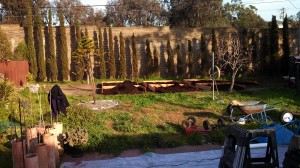 There will be growth in the spring I can promise you that . . . and a little more work but I am so looking forward to the fruits of my labor. Tomatoes are my favorite of all vegetables (technically a fruit but go with me here) with at least one bed will be dedicated to those magnificent Romas, and a sprinkling of heirlooms mixed in just for fun.
Now is a fantastic time to get out in your yard or on to your porch and get your garden started. Even if all you have is a 3′ x 3′ spot just outside your door that gets great sunlight I encourage you to start a tomato plant or two. Pair that with another pot sprouting basil and you will have some amazing eats in just a few months. Go ahead I say, don’t be afraid to get your hands dirty.
Eat Well and Smile Often,
tj
p.s. Ah basil, how I just love basil! and tomatoes, how I just love tomatoes! and mozzarella, how I just love mozzarella!
 But at least my shoes are not still warm!!
 Ah! The magic of Thanksgiving lies not in the gratitude we openly express for life’s gifts, large or small. No, no, no . . . the magic lies in the GRAVY!!
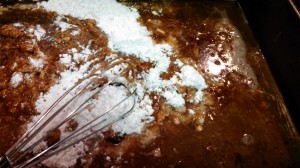 After you have taken the bird from the oven, remove it to a dish or cutting board to stand for about 15 – 20 minutes before carving. This is the time to knock out ‘Le Piece de Resistance’ of the meal: the pan gravy. Start by placing the pan across one or two burners of your stove and turn them on low. Just enough that the fat and juices begin to bubble. For my 13lb turkey recipe there were enough drippings from the bird and the herbed butter to need about 2/3 cup of flour to thicken. This is a judgment call on the cook’s part.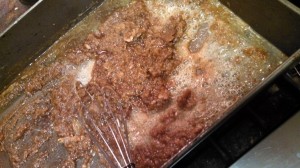
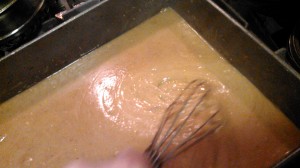
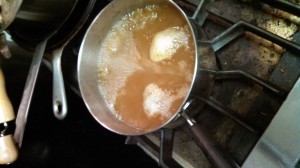 Whisk the flour and all of the drippings together over the low heat and cook the roux until it bubbles and gets a little fluffy, stirring occasionally to even out the cooking. This process literally opens up the starch in the flour and allows it to absorb more liquid than when it is raw. While the roux is cooking, place some chicken broth in a separate saucepan and bring it to a gentle boil. If I could find a commercial source for turkey broth I would have used that. In the restaurant there were always turkeys being roasted for sandwiches and we would save the bones and make a stock from them. Chicken or turkey, both add great flavor. I used a 32 oz container of unsalted broth and made one quart of gravy . . . almost enough!
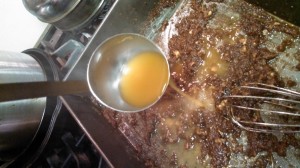 After the roux has cooked sufficiently, about 5 minutes, turn off the heat and let it cool for about one minute. Then gently ladle in one-ladle-full of boiling broth and whisk together well. After it has fully incorporated repeat this step 3 or 4 more times. Turn the heat back on low under the pan to cook the gravy while whisking. Having hot broth and a little bit of patience whisking it in will give you a smooth gravy, the envy of every wanna-be sauce make out there. Turn the heat off under the broth and now you can start pouring it in to the pan in greater volumes whisking until fully incorporated each time. Heat the gravy for about 2 minutes while whisking then turn the heat off under the pan and serve.
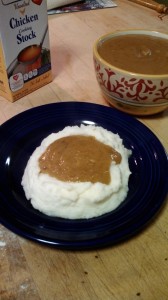
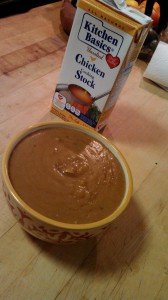
 Since I used a brined turkey my drippings were already salted. My mother would add some Worcestershire sauce for extra spice. (Fair Notice: I had to grab a bottle from the refrigerator in order to spell it correctly.) I simply stuck a spoon into the gravy then into my head and tasted it. Lovely!! As you see in the picture above it went extremely well with my snack of mashed potatoes.
 Check back Wednesday for the final installment of Thanksgiving recipes.
 “Tell me what you eat, and I will tell you what you are.”
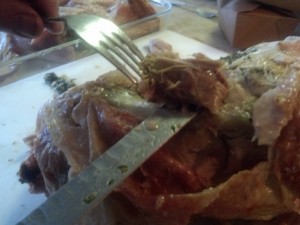 The oyster meat, for those of you who are unfamiliar with it, is located at the point where the thigh connects to the body of the turkey. I recommend removing the legs and thighs first by cutting through the joints. Flip the bird gently on to its breast and just above the point where the thighbone was connected to the body, there will be a small ‘oyster’ shaped piece of flesh that is very flavorful. My suggestion: Don’t tell any of your guests and save it for leftovers.