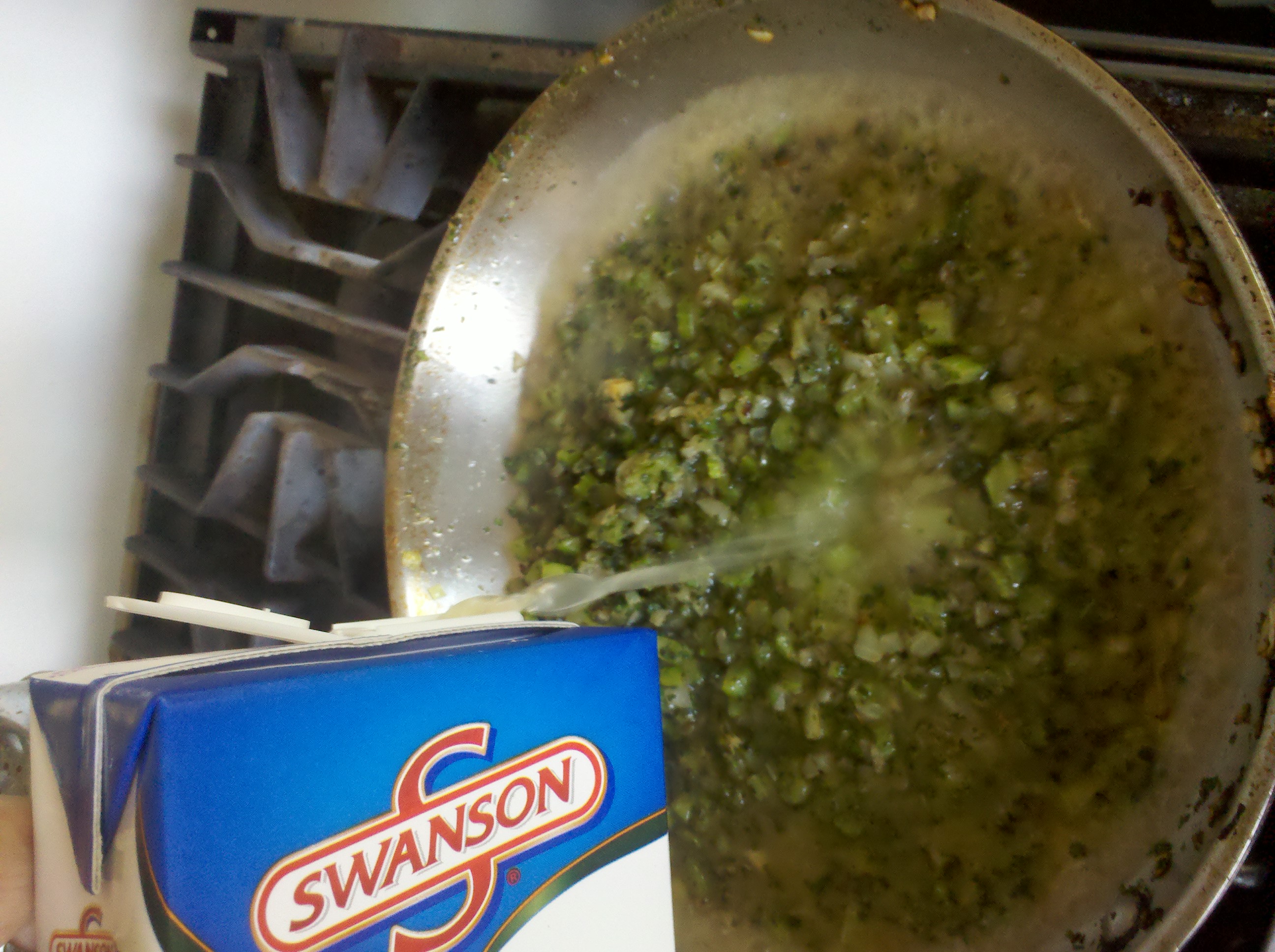
 I recently got called on my cooking BS.
“Rice pilaf,” I exclaimed, “is purely a dish of western creation.” You see, I received formal training in classical French cooking techniques and . . . well . . . all the best food and cooking techniques come from France. Right?! I was caught in my little white lie by two very talented female chefs who replied, “That doesn’t sound quite right.” They were right, I was wrong. Um, it seems I forgot one part, the one where Everyone-Else-In-The-World cooks too. To state it correctly, Rice Pilaf is a Middle Eastern dish and our word Pilaf comes from the Turkish word Pilav. Oops, my bad.
 Now to the title of this piece and how Pilav became Pilaf. In 1533, at the age of fourteen, Catherine de Medici of Italy married Henry II, king of France. Henry, to our benefit you’ll soon discover, was much more interested in his mistress Diane de Poitiers than his new bride. Catherine as a result was excluded from politics and all things court like. Instead of staying by her husband’s side she traveled the country with her entourage. Here comes the good part. The Italians, being the great travelers and traders they are, brought back not only goods for commerce but great heaps of culture from around the globe. In Catherine’s entourage were chefs schooled in cross cultural cooking techniques and the dishes they inspired. As they progressed around France, Catherine chefs would require the assistance of local cooks to prepare the Queen’s meals. Catherine moved on but the cooking techniques remained, Pilaf included. While there has been some trifling debate as to whether Catherine actually had this much effect on French cuisine, those of us who study it can precisely time its rise to the Renaissance period. So there!
Did she or didn’t she? I believe she did. Is it wrong of me to be grateful of the King’s infidelity?
Eat Well and Smile Often,
tj
p.s. I thought all the best chefs were men! Ooops, my bad.
Simple Rice Pilaf
1 cup Rice
3 Tbsp Butter or olive oil
2 cups Water or broth
2 Tbsp Parsley, chopped
Place in a sauce pan water or broth and bring to a boil. Add a pinch of salt if water only.
In a sauté pan heat butter or olive oil over medium heat and add rice. Cook for about 4 minutes.
Add rice to boiling liquid, stir, reduce heat to very low and cover. Cook until all the liquid is gone. Remove from heat, mix in parsley and serve.
Originally posted on April 30, 2012
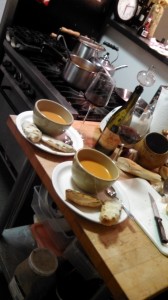 What to do? What to do? What to do? A winter’s day ripe for hot tomato soup and grilled cheese sandwiches. But, tomato season is over and I just can’t get my self to buy those pale pink, baseball hard orbs the grocer labels as tomatoes. I remember my mother trying to get the Kids to eat vegetables during the winter and serving us these rock hard, white tomatoes with a wedge of iceberg lettuce and an oversize portion of bleu cheese dressing. Yes, health was on her mind.
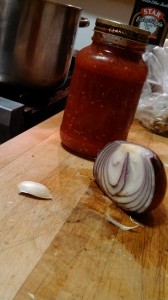 Anyway, this weekend the rain was coming down and Suzanne and I were hankering for something warm and satisfying. Tomato soup sounded great but alas . . . no fresh tomatoes. Wait!! That is not entirely true. While they were not fresh off the vine in the minute, I did have a jar of tomatoes that I put up right after picking. I reached into my pantry and came out with a quart jar of lovely ripe, stewed tomatoes. One of the great challenges of having an edible garden is using all of its produce. This year I went heavily into tomatoes and was rewarded with a bumper crop. Take a minute to review my
  The next step is my favorite. I like to blend my soups. Now some cooks like to use immersion blenders, those little electric motor sticks with wimpy little blades that barely move your soup around the pot. Me, I like using a blender on low speed until I get the texture I want. And . . . every once in a while I forget to keep my hand on the lid and oops, I get a little messy. Occasionally I will strain my soup to remove any extra chunky bits. I tried that this time and was not happy with the results so I dumped the solids back into the pot and was happy that I did.
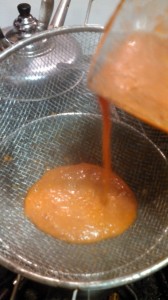 Giving the puree’ a taste test I found the soup to be a little flat so I added just a pinch of kosher salt. Wow!! Did that pick the flavors right up. Normally I would add some acid to brighten the flavor but the tomatoes brought just enough to the dish so no vinegar was needed.
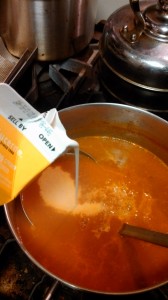 Fortunately for me she did not stop there. Suzanne also whipped up a little fresh pesto which she used to coat a slice of freshly baked baguette. On top of which she added slices of Gruyere and Mozzarella. Get that all melty in the toaster oven and Man!! What a meal.
 So, this last rainy weekend, Suzanne and I tucked into freshly baked bread topped with pesto and cheese with a steaming hot bowl of tomato cream soup. Took the shivers right away. My advice is: If you find yourself wanting for grilled cheese and soup one rainy day, dig a little deeper into the pantry and see just what might make make the day a little brighter.
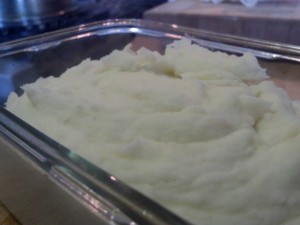 Mashed potatoes and stuffing!! Are you freaking kidding me?? Why are we not eating these with every meal??
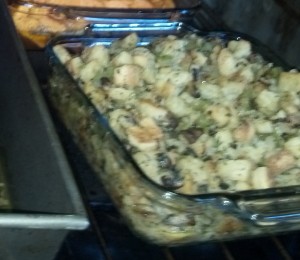 Ah the heck with it, it’s Thanksgiving and I for one, like every good American, plan to overindulge this holiday season. This means that multiple helpings of mashed potatoes and stuffing will make it off of my plate, on to my fork and into my head. Fork one, napkin two, fork one, napkin two.
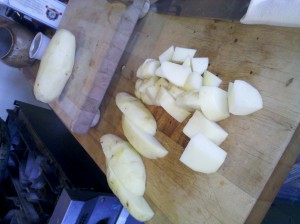 Place diced potatoes in a sauce pan with enough cold water to cover. Add 1 tablespoon salt, place on high heat and bring to a gentle boil. Cook for about 15 minutes checking with a fork for doneness regularly. (Yes, doneness is a word.) Place a clean colander in an empty sink.
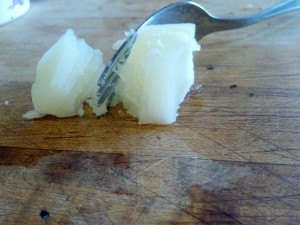 The potatoes should just yield to the pressure of a fork. Take the pot off of the heat and pour potatoes and water through the colander. Return the potatoes and place back on the stove on high heat for one minute to boil off any excess fluid.
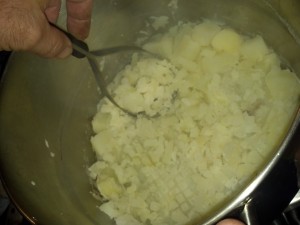 Turn the heat off and with a mashing tool mash the potatoes until the lumps are gone. With a whisk begin whipping the potatoes. Add the sour cream and butter and whip until the potatoes are smooth in texture. Do not over whip. This will make the potatoes gluey.
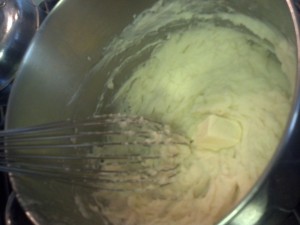 Add salt and white pepper and extra butter to taste. Place in an oven proof dish, cover and place in warm oven to keep while your turkey is standing.
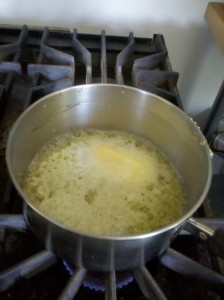 In a sauce pan place butter, olive oil and garlic. Heat over medium heat until butter starts to bubble. In a large bowl toss garlic butter and diced English Muffins. Place onto a baking sheet and place baking sheet in to a preheated 350° F oven. Bake until browned about 30 minutes. (This part can be done the day before with no loss of quality.) (You might want to double this part of the recipe and put the croutons out for snacks . . . damn good!!)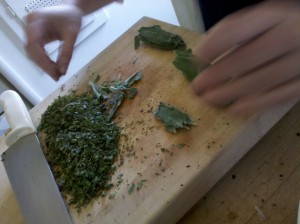
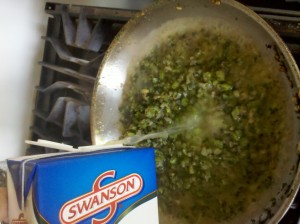 In a clean saute’ pan place 2 T of olive oil and place on medium high heat. When the oil begins to shimmer add the diced onion and celery. Stir and/or toss to cook slightly. After about 5 minutes add the mushrooms and the herbs and stir. Let cook for one minute then add the chicken broth. Simmer over medium heat for about 5 minutes then remove from heat.
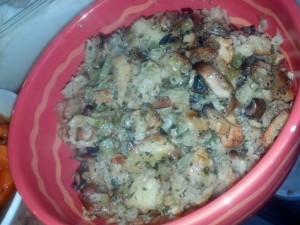 In a large mixing bowl mix the croutons and the vegetable mixture with broth. Place the moistened croutons in to a baking dish and bake for 1 hour at 350° F. Serve and enjoy!!
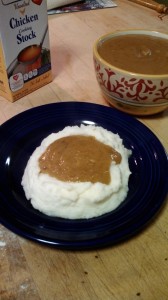 Ah! The magic of Thanksgiving lies not in the gratitude we openly express for life’s gifts, large or small. No, no, no . . . the magic lies in the GRAVY!!
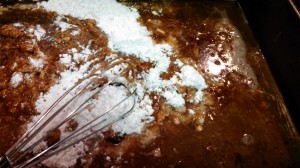 After you have taken the bird from the oven, remove it to a dish or cutting board to stand for about 15 – 20 minutes before carving. This is the time to knock out ‘Le Piece de Resistance’ of the meal: the pan gravy. Start by placing the pan across one or two burners of your stove and turn them on low. Just enough that the fat and juices begin to bubble. For my 13lb turkey recipe there were enough drippings from the bird and the herbed butter to need about 2/3 cup of flour to thicken. This is a judgment call on the cook’s part.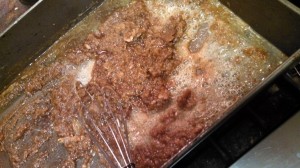
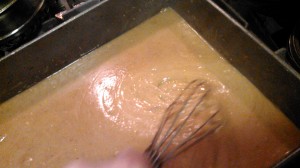
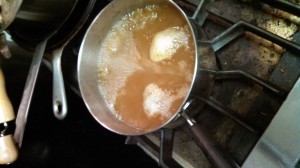 Whisk the flour and all of the drippings together over the low heat and cook the roux until it bubbles and gets a little fluffy, stirring occasionally to even out the cooking. This process literally opens up the starch in the flour and allows it to absorb more liquid than when it is raw. While the roux is cooking, place some chicken broth in a separate saucepan and bring it to a gentle boil. If I could find a commercial source for turkey broth I would have used that. In the restaurant there were always turkeys being roasted for sandwiches and we would save the bones and make a stock from them. Chicken or turkey, both add great flavor. I used a 32 oz container of unsalted broth and made one quart of gravy . . . almost enough!
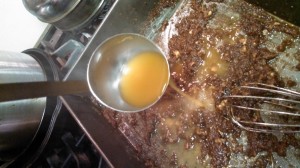 After the roux has cooked sufficiently, about 5 minutes, turn off the heat and let it cool for about one minute. Then gently ladle in one-ladle-full of boiling broth and whisk together well. After it has fully incorporated repeat this step 3 or 4 more times. Turn the heat back on low under the pan to cook the gravy while whisking. Having hot broth and a little bit of patience whisking it in will give you a smooth gravy, the envy of every wanna-be sauce make out there. Turn the heat off under the broth and now you can start pouring it in to the pan in greater volumes whisking until fully incorporated each time. Heat the gravy for about 2 minutes while whisking then turn the heat off under the pan and serve.
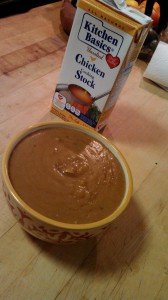
 Since I used a brined turkey my drippings were already salted. My mother would add some Worcestershire sauce for extra spice. (Fair Notice: I had to grab a bottle from the refrigerator in order to spell it correctly.) I simply stuck a spoon into the gravy then into my head and tasted it. Lovely!! As you see in the picture above it went extremely well with my snack of mashed potatoes.
 Check back Wednesday for the final installment of Thanksgiving recipes.